


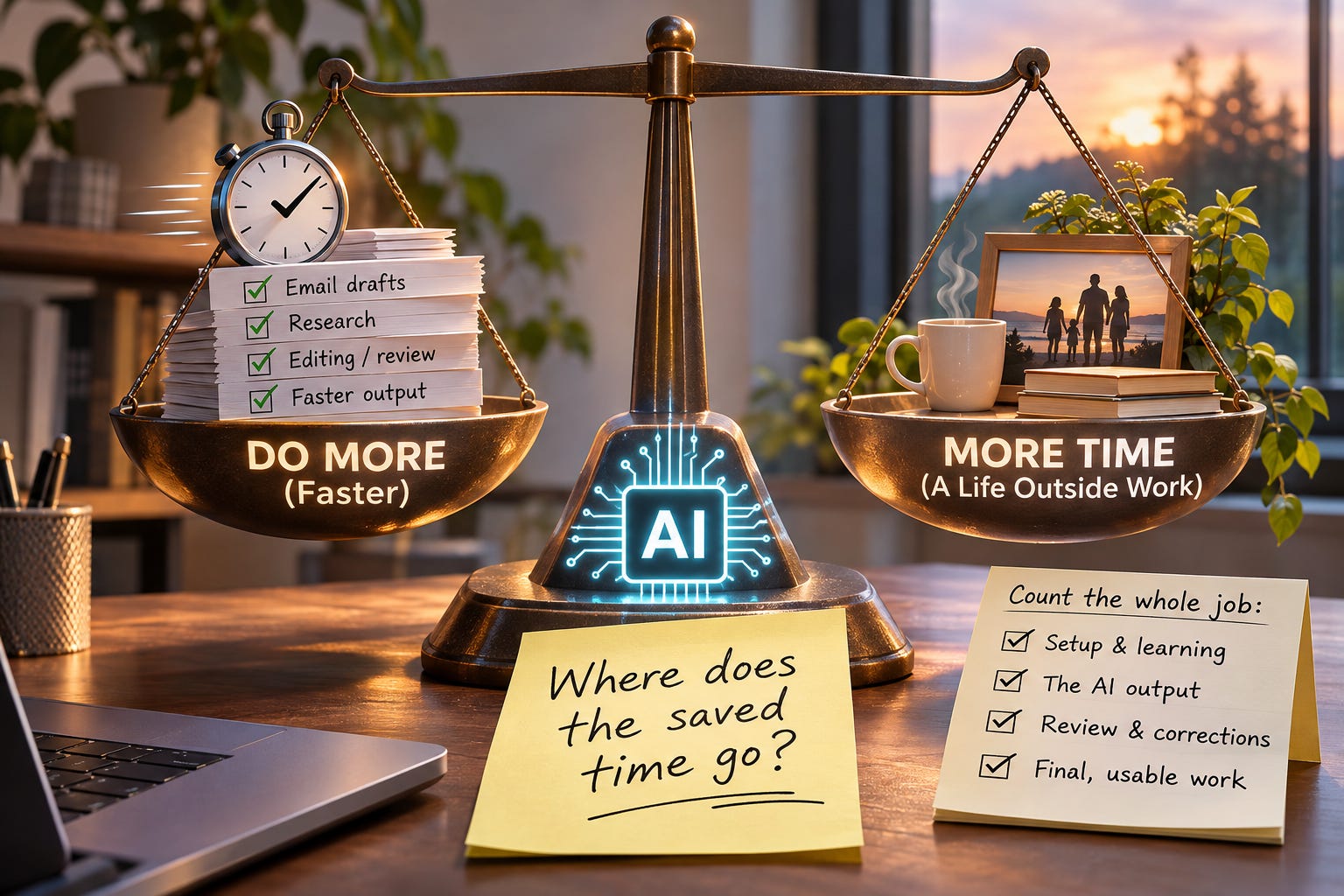
I like the tools. I’m less convinced we’re being honest about where the saved time goes.
I started with a question about whether my AI assistant could help with email. Before long, I was asking about separate personas, Slack, voice conversations, making phone calls, and whether I needed a more powerful setup.
Apparently, my approach to having too much to do is to investigate several new things I could set up.
This is why I want to talk about AI and time. I love this technology. (Full disclosure: Tom Gorczynski and I co-founded AskTomG.AI, so I have a business interest in this too.) I’m interested in what these tools can do for our profession, and I enjoy figuring them out. This isn’t a complaint from someone who wishes everyone would go back to a legal pad.
But I want to separate two things we keep treating as interchangeable: doing a task faster and having more time for a life outside work.
Count the whole job
In my March article, Stop Typing, Start Talking (But Watch What You Say), I wrote about voice dictation and the difference between knowing what I wanted to say and getting it onto the screen. That was a specific problem with a useful solution. I also wrote that my dictated drafts needed editing. The time at the microphone wasn’t the whole job.
The same question belongs in any discussion of AI productivity.
Suppose you ask an AI to draft an email. The draft arrives almost immediately. Then you read it, remove a promise you never authorized, fix the tone, and check that it answered the question the person asked.
That may still be much faster than writing it yourself. Good. Count that improvement. But count the review too.
For tax research, getting a plausible answer isn’t where I would stop the clock. I would stop after checking the sources, deciding whether they apply, and getting the work into a form I can use. A polished answer that sends me down the wrong path hasn’t saved me time just because it arrived quickly.
Don’t try to outsource the job of being a competent tax professional to AI.
Measure the time to work you can use, not the time to text on a screen.
I can turn this into another project
There is also the work we do before the tool starts helping.
Picking a service. Connecting accounts. Explaining how we work. Testing whether the assistant understands the difference between drafting an email and sending one. Fixing the thing that worked yesterday.
Some of that is a sensible investment. A process you use repeatedly may justify substantial setup. A tool can also let you do something worthwhile that you couldn’t have done before.
But learning a new system because I enjoy technology and implementing one because it will save time are different activities. I can enjoy both. I should be honest about which one I’m doing. I am not always honest about this.
Tim Ferriss made a related point in a recent Q&A on The 4-Hour Workweek in a world of AI. His argument is that AI amplifies whatever you point it at. Decide what matters (and what to drop) before you automate anything. Otherwise you just get faster at work that didn’t need doing.
In The Post-Deadline Drift, I wrote about how technology is something I love that can creep back into work territory. AI gives that tendency plenty of opportunities. There is always something else to connect, another workflow to test, or a slightly better way to organize the result.
Sometimes the useful decision is to leave a working system alone.
What happens to the time?
Let’s say the tools work. The setup pays off. The finished work is good, and it takes less time.
You could use that capacity to grow your practice. You could give a difficult case more attention, catch up on work that’s overdue, or make the day less frantic. Those are worthwhile outcomes, even if you still leave at the same hour.
You could also accept more work until you’re just as overloaded as before.
I’m not the only one noticing. In March, Cal Newport wrote Why Hasn’t AI Made Work Easier? about ActivTrak research that tracked 164,000 workers. After people started using AI, their time in email, messaging, and chat more than doubled, and their focused, uninterrupted work fell 9%. People got busier. The work that matters most didn’t get more room.
That’s the part I want us to acknowledge. A practice producing more and an owner working less are different outcomes. Either can be a deliberate choice. Trouble starts when we promise ourselves the second while building everything around the first.
It also matters who gets the benefit. If someone on your team finishes a recurring task faster and immediately inherits another assignment, the firm may be getting more output. That person’s day may not feel any easier. It reminds me of companies that require everyone at a desk from 8 to 5 no matter what. Finish early, and the reward is another assignment.
Before calling that a quality-of-life improvement, ask them.
Try it on one thing

I wouldn’t start by rebuilding the practice around AI. Pick one recurring task that’s annoying enough to improve and small enough to evaluate.
For a week or two, keep a simple record:
How long does it normally take to finish?
How much time does the AI-assisted version take, including instructions, checking, and corrections?
Is the finished work at least as good?
What setup or maintenance does it require?
What happened to the time you gained?
Use a task and information you’ve determined are appropriate for the tool. This isn’t a reason to start feeding client files into whatever app happens to be convenient.
If it helps, keep it. If it doesn’t, you don’t have to keep using it to prove you’re interested in technology. And if the benefit is better work rather than less time, say that. Better work is worth paying for too.
Decide what you want to do with the savings before the next request arrives. Maybe you’re trying to make room for another client. Maybe you want to stop answering email after dinner. Those goals call for different decisions once the task is finished.
I’d like some of it back
In You Can Do Anything - But Not Everything, I wrote about the limits of our time and attention. AI makes more things possible. It doesn’t settle which ones deserve our attention.
I want the help. I also want time with family and friends that doesn’t depend on finally reaching the bottom of a list I keep adding to. And I am very good at adding to the list.
I’m not giving up the tools. I’m asking them, and myself, for something more useful than a larger pile of completed work.
Are these tools giving you time back? Or are you getting more done and still finishing the day at the same time? I’d like to hear about a specific task that changed your day, including the ones where the promised savings never showed up.
P.S. What’s one thing you would like to know about implementing AI? I’ll pick a couple of questions and do deep dives on them.
Loved this article. I'm guilty of all of it. It has made my output better but I don't think I'm saving time, just allocating it differently. With this in mind, it's hard to see this as a cost saving tool as much as it simply reorients the way I work and makes my deliverables better quality.