


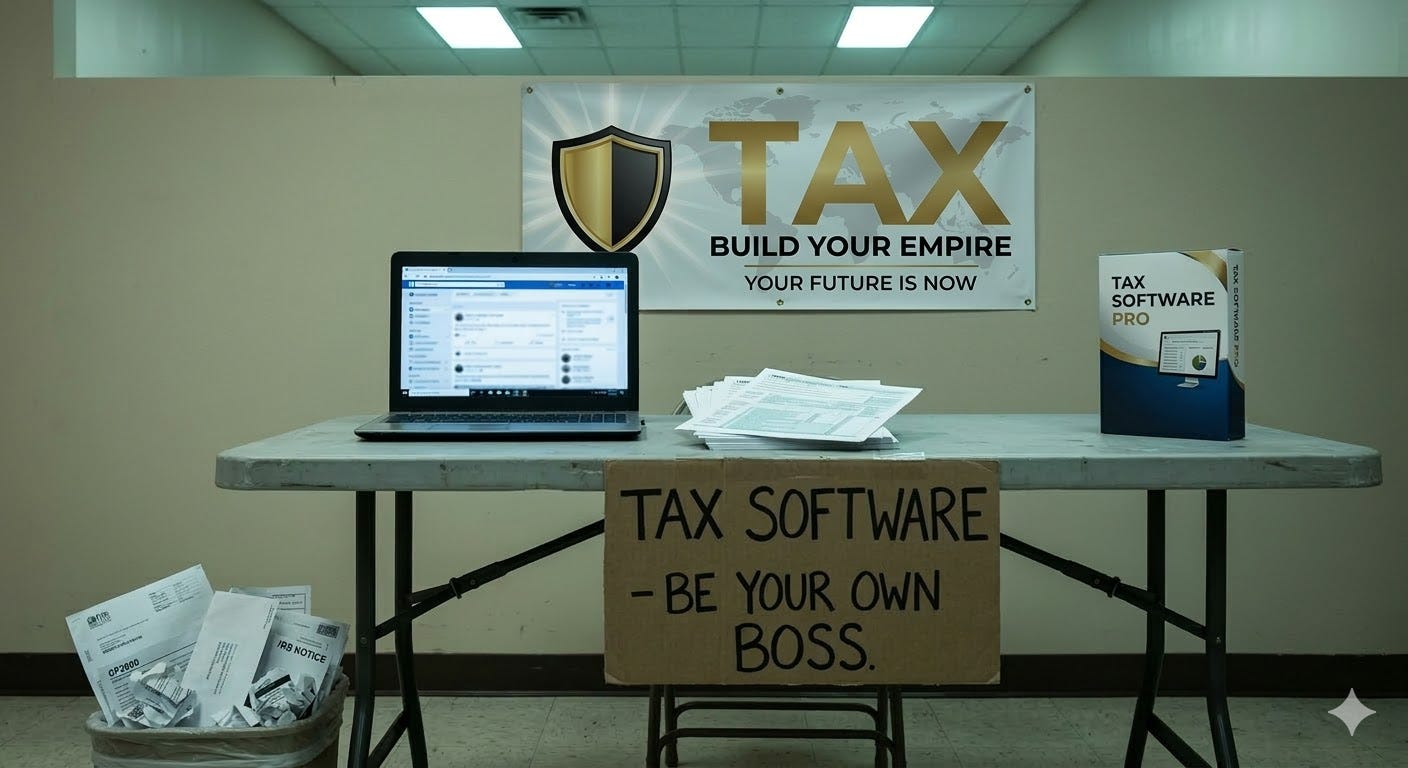
If you spend any time in tax professional Facebook groups, you’ve seen the posts. Confession, sometimes at night, to unwind, some friends (you know who you are), and I may peruse the groups a bit. It is terrifying to say the least. Someone’s pitching their “service bureau” with promises of passive income, white-labeled software, and the ability to build an empire without preparing another return. The comments fill up with fire emojis and “DM me for details.”
And if you’ve been doing this long enough, you’ve also seen the other posts. The ones from preparers who got burned. The ones asking why their EFIN was compromised. The ones wondering where all those fees came from that got pulled out of their client’s refund.
Let’s talk about what a service bureau actually is, where the model works, where it goes wrong, and why the real problem is bigger than any single bureau.
What Is a Service Bureau?
A tax service bureau is a reseller of professional tax preparation software. A tax professional contracts with an established software company (CrossLink, TaxSlayer Pro, Sigma Tax Pro, UltimateTax, and others), purchases software licenses at a discounted rate, brands the software with their own logo, and resells it to other preparers at a markup.
The bureau is supposed to provide more than just software. Training, support, bank product onboarding, the kind of personalized service a large vendor can’t offer every small office. The idea isn’t inherently bad. Some service bureaus are run by credentialed, experienced professionals who genuinely support their preparers.
The problem is how easy it is to become one without being any of those things.
Follow the Money
Service bureaus don’t make money from a single source. They stack fees. And the people absorbing those fees often don’t know the full picture.
Software license fees. The bureau buys licenses at a discount and resells them at whatever price they choose. Some charge $1,000 or more per license per year. One accelerator program encourages bureau owners to sell ten licenses at $1,000 renewal fees each, collecting $10,000 the following year without making a single new sale.
Service bureau fees. Every time a preparer files a bank product return, the bureau collects a fee directly from the taxpayer’s refund. Bureau owners can set this fee up to $99 per funded return. One software provider disclosed an average total fee per funded bank product of roughly $93, and that’s before the preparer’s own fee gets deducted.
Revenue splits. Some bureaus take a percentage of the preparer’s preparation fees. Common splits are 70/30, 80/20, or 90/10, with the smaller number going to the bureau. If you’re giving up 10 to 30 percent of your prep fees to someone who sold you software, you should know exactly what you’re getting in return.
Add-on fees. Technology fees, transmitter fees, audit protection fees, e-filing fees. These stack on top of everything else.
Recent fee surveys put the national average for a simple Form 1040 with standard deduction in the low- to mid-$200s. Studies consistently show credentialed preparers charge more than non-credentialed ones, which makes sense given the education involved. But when a service bureau preparer charges a comparable fee and then layers on $99 in bureau fees, $44 in bank fees, and another $30 or $40 in technology and transmitter fees, a taxpayer expecting a $300 bill sees $450 or more come out of their refund.
The taxpayer doesn’t understand the breakdown. The preparer sometimes doesn’t either.
Who Gets to Be a Service Bureau?
This is where it gets uncomfortable.
Multiple service bureau programs advertise that there are no specific requirements to become a bureau owner. No credential. No experience. No exam. One major software provider states this explicitly on their website. If you’re “business-minded” and willing to pay, you’re in.
Some programs go further. “Nesting” arrangements let preparers who don’t have their own EFIN file returns under the bureau’s EFIN. One program advertises “no EFIN required” and offers preparers up to 60% of the preparation fee while working under the bureau’s credentials. Publication 3112 makes EFINs non-transferable and prohibits renting, leasing, or otherwise sharing them; providers who do so can be sanctioned, including suspension or expulsion from the e-file program. Yet EFIN sharing gets marketed as a feature.
If someone can’t pass the IRS suitability check on their own, possibly because of criminal history or compliance violations, the answer should not be to let them file returns under someone else’s number.
The accelerator programs pitch themselves as turnkey businesses. Pay a one-time fee, get white-labeled software, a custom logo, social media templates, and unlimited licenses. Testimonials talk about making $40,000 before tax season starts, just from selling software. One describes the model as “one of the easiest ways to make money in the tax industry without working so hard.” The focus is revenue generation, not return accuracy.
The Damage
Low-income taxpayers get hit hardest. The people most affected by fee stacking are taxpayers claiming the Earned Income Tax Credit. They can’t afford to pay up front. They need their refund the most. And they lose the largest percentage of it to fees they didn’t fully understand. This will only intensify now that, under Executive Order 14247, the IRS has generally stopped issuing paper refund checks for individuals and is pushing most taxpayers toward electronic refund options. More taxpayers steered toward bank products means more opportunities for fee stacking.
Ghost preparers thrive in this ecosystem. The IRS’s 2026 Dirty Dozen list, released March 5, includes ghost preparers at number eight. Ghost preparers file returns without signing them or including a PTIN, leaving taxpayers on the hook for everything on the return. When the barrier to entry is low enough, and EFIN sharing exists, ghost preparers operate under a bureau’s credentials without ever being individually accountable. In August 2025, a ghost preparer in Augusta, Georgia, was sentenced to 22 months in federal prison for fabricating income, charging percentage-based fees, and never providing clients with copies of their returns. This week, a preparer in Allentown, Pennsylvania, was charged in a $5.5 million fraud scheme on top of a prior $4.3 million scheme that had already resulted in prison time.
The data security gap is real. Under the Gramm-Leach-Bliley Act and the FTC’s Safeguards Rule, every tax return preparer is required to have a Written Information Security Plan. When a service bureau distributes software to dozens of preparers across multiple offices, who is responsible for the taxpayer data flowing through the system? Does the bureau have its own WISP? Do the individual preparers? Is anyone conducting risk assessments? In most cases, the answer is no.
The Number That Should End the Debate
The National Taxpayer Advocate’s 2026 Purple Book, released in January, includes a recommendation that Congress authorize the IRS to establish minimum standards for federal tax return preparers. The data behind that recommendation is hard to argue with.
In fiscal year 2024, 27.3% of EITC payments were estimated to be improper, totaling $15.9 billion. Among EITC returns prepared by paid preparers, 96% of the total dollar amount of audit adjustments was attributable to returns prepared by non-credentialed preparers.
Federal and state laws require licenses for lawyers, doctors, financial planners, barbers, and beauticians. Most paid tax return preparers have no competency requirement at all.
I want to be very clear about something: just because you are not licensed does not mean you are not competent. There are unlicensed tax preparers who know more and do a better job than licensed people. Having letters after your name does not mean you are all-knowing. Believe me! But having some minimum requirement in place would be a good start.
The IRS tried once. The Registered Tax Return Preparer program would have required testing and continuing education for unenrolled preparers. Loving v. IRS struck it down in 2014 because the court said the IRS lacked statutory authority. Congress has not given them that authority in the twelve years since. The Obama, first Trump, and Biden administrations all recommended it. A bipartisan Senate discussion draft from Finance Committee Chair Crapo and Ranking Member Wyden proposes increased preparer penalties, jumping the failure-to-sign penalty from $60 to $250 and the due diligence penalty from $635 to $1,000. Those are steps in the right direction, but penalties after the fact are not prevention.
What Should Change
We need more people in the tax profession. Experienced practitioners are retiring, and the pipeline isn’t keeping up. Nobody disputes that. But there’s a difference between lowering barriers to entry and removing guardrails entirely.
Federal minimum competency standards for paid preparers. Testing and continuing education for anyone who prepares returns for compensation. Three administrations have recommended it. The National Taxpayer Advocate has recommended it. Congress needs to stop waiting.
Credential requirements for service bureau owners. If you’re distributing software, collecting fees from taxpayers’ refunds, and onboarding preparers under your brand, you should be an EA, CPA, or attorney.
Consistent EFIN enforcement. The rules already exist. Publication 3112 prohibits EFIN sharing. If the IRS deactivated EFINs aggressively when sharing is detected, the EFIN-as-a-service model collapses.
Transparent fee disclosure. Taxpayers should see a clear, itemized breakdown of every fee coming out of their refund before they consent to a bank product. Service bureau fees, technology fees, transmitter fees, and preparation fees listed separately, in plain language.
Practitioner due diligence. If you’re considering signing up with a service bureau, ask hard questions. What credentials does the owner hold? What fees hit your clients’ refunds? Are they asking you to use their EFIN? Do they have a WISP? What happens when a return gets flagged? If the answers are vague, or if the pitch is more about your revenue than your clients’ returns, walk away.
The Bottom Line
The service bureau model isn’t going away. It fills a real gap for independent preparers who need affordable software and support. But the absence of regulation, the nonexistent barrier to entry, and the incentive structure that rewards volume over quality have created an environment where exploitation thrives.
Every fraudulent return filed under a service bureau’s EFIN, every taxpayer who loses a chunk of their refund to fees they didn’t understand, every ghost preparer who fabricates credits and disappears after April 15 erodes the public trust that voluntary compliance depends on.
$15.9 billion in improper EITC payments tells us exactly what the cost of inaction looks like.
How We Can Fix It
I spend a lot of this article talking about what’s broken. We should always seek solutions to problems, or we are just complaining, and that doesn’t solve anything. I want to end with something that’s working.
I serve on the scholarship committee for the National Association of Enrolled Agents (NAEA), dedicated to helping aspiring enrolled agents reach their career goals. The foundation provides SEE exam prep course scholarships, reimbursement of exam registration fees, National Tax Practice Institute (NTPI) Level 1 scholarships for practitioners entering representation work, and college scholarships for students pursuing accounting and tax careers. The next scholarship window opens May 1.
If we want more qualified people in this profession, and we do, this is how we get them there. Not through a turnkey software package and a Facebook group. Through education, testing, continuing education, and mentorship. The license must mean something because you have to earn it. Personally, I also want to see more required education and stronger vetting to ensure quality. Getting a license is an important first step, but the learning never stops.
If you’d like to learn more or donate, visit the NAEA Education Foundation.
What are your thoughts? Have you been impacted by this?
These groups also have a high rate of self -reported due diligence audits and due diligence warning letters from the IRS.