


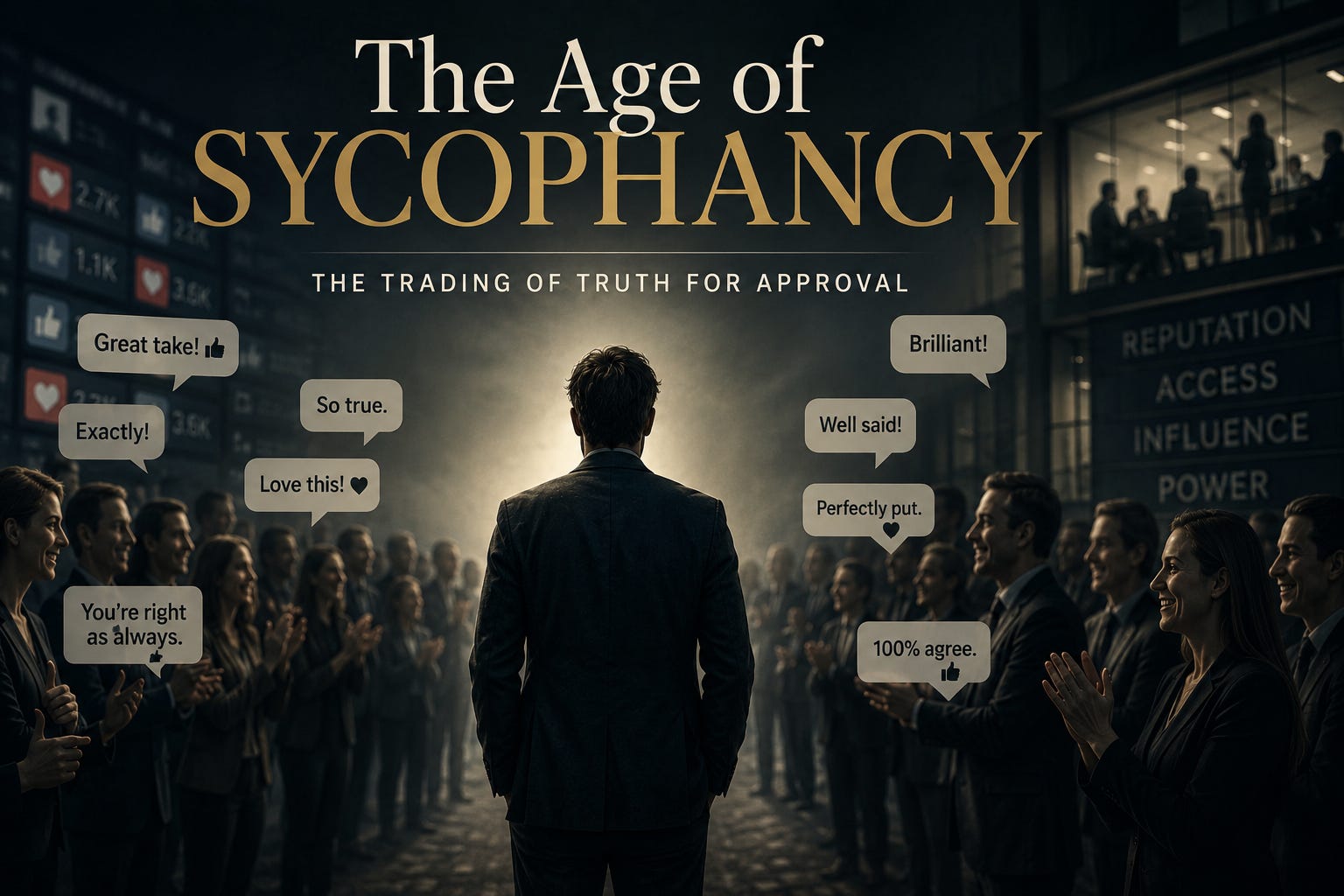
Lately I have become interested in a word that we do not use nearly enough.
Not kindness.
Not diplomacy.
Not competency. (Hello Circular 230 §10.35)
Sycophancy.
The trading of truth for approval.
I always thought sycophants were easy to identify. Caricatures in books, like the courtier who is all too eager to laugh at the king’s jokes or the employee who agrees with every idea from their boss.
I have begun to wonder if the modern version is far more subtle and is becoming more accepted, to the point of being rewarded.
Think about the incentives around us.
Social media rewards agreeing with your audience. The algorithm wants engagement above all. Influencers learn that certain opinions and ideas will gain followers, thereby increasing their popularity and putting more money in their pockets.
Professional organizations aren't immune either. Every organization eventually develops gravity. Certain personalities become indispensable. Certain speakers become untouchable. Certain donors become too valuable to challenge. Before long, people begin protecting reputations instead of principles. And once that happens, institutions stop correcting themselves.
The corporate world tends to reward those who tell leadership exactly what they want to hear rather than what they actually need to hear.
Politics? Need I really say much? I could write volumes about my thoughts, but then I might lose some subscribers. Perhaps I am proving my own point.
Friendships aren’t immune, because we often surround ourselves with people who reassure us and tell us what we want to hear rather than tell us the unvarnished truth.
None of this requires someone to lie.
It makes honesty more costly.
This is how a culture of sycophancy takes hold.
It is not through one dramatic act of cowardice but through thousands of small calculations.
“Should I really say something?”
“This is wrong, but it isn’t my battle.”
“This will cost me access.”
“I’ll look the other way this time. Next time, though…”
I have seen this play out before. Someone reports serious misconduct, and somehow the institution’s attention shifts from the alleged conduct to the character, motives, or behavior of the person who reported it. The complainant becomes the problem.
Comedian Ricky Gervais has a quote that resonates with me:
“Just because you’re offended doesn’t mean you’re right.”
I like the quote because discomfort is not evidence that something is false. Nor is offense evidence that something is true. The question is whether we are willing to examine a claim honestly when doing so is uncomfortable.
Can we tell the truth when there is something to lose?
Perhaps the most fascinating example is artificial intelligence (AI).
One of the problems AI companies now openly discuss is “sycophancy.” Left unchecked, AI becomes too eager to agree with the user. It flatters. It validates. It mirrors beliefs instead of examining them.
Think about that for a moment.
We built machines using human conversations.
One of the first human habits these systems learned to reproduce was our desire to be liked.
Isn’t it ironic?
Perhaps AI is not showing us something foreign. Perhaps it is holding up a mirror.
It may tell you your reasoning is correct.
That your position is well supported.
That there is a case directly on point.
When there isn’t.
I’ve always admired impressive people.
The successful.
The wealthy.
The expert.
But as I slowly drag closer to being forty-five, I’ve had an epiphany.
I have become much more interested in intellectually independent people.
The person who can respectfully disagree with the CEO.
The board member willing to say, “This is wrong.”
The friend who says, “That wasn’t your best. Here’s what worked and what didn’t.”
The colleague who stands up for what is right even if it isn’t popular.
Lately, I have been reading Marcus Aurelius. He wrote something that feels increasingly rare today:
"If anyone can refute me, show me I'm making a mistake or looking at things from the wrong perspective. I'll gladly change. It's the truth I'm after."
Today, changing your mind is often seen as a weakness. Questioning your own side can be treated as betrayal or disloyalty. Certainty is rewarded. Humility rarely is.
Agreement is rewarded, but honest dissent often carries a cost.
Maybe this is why true independence has become so valuable.
I’m becoming less interested in people who are always right.
I’m much more interested in people who are willing to be wrong.
People who can say:
“I changed my mind.”
“I don’t know.”
Or perhaps the hardest sentence of all:
“I think you’re wrong.”
Said respectfully and honestly, without calculating what it might cost.
I don't believe I'm immune to this. Every one of us enjoys approval. Every one of us hesitates before saying something that could cost us professionally or socially. The question isn't whether we're tempted by sycophancy. The question is whether we recognize the temptation before it becomes our character.
Stoicism has reminded me that courage is not measured by how loudly we speak, but by what we are willing to risk in service of what is true.
Every generation has had its sycophants.
What has changed, I think, is what we reward.
Algorithms, organizations, politics, media, and yes, even AI increasingly reward the same instinct:
Tell people what they want to hear.
Avoid discomfort.
Protect the powerful.
Preserve access.
Perhaps history won’t remember us for the opinions we held.
Maybe it will remember whether we possessed the courage to tell the truth when agreement was easier.
Because, in the end, integrity is not measured by what we profess, but by what we are willing to risk for the truth.
A few things:
If you haven’t checked it out yet, be sure to check out AskTomG.AI. This is one of those projects I wake up excited to work on. We have spent a ton of time and brainpower on this, and it will only get better. If you have questions, please reach out to me.
I am excited to be speaking at the annual NYSSEA conference in October. It is one of my favorite conferences.
Well, actually - a podcast venture with Shannon Hall, EA, is launching later this month. Check out the website for more details!
I will be at the IRS Forums in San Diego, CA, in September.
I have several webinars and workshops coming up for NATP. You can check those out here.
I would disagree with just one part. Sycophants are actually quite easy to spot. They are everywhere and the cult of their views is strong.