


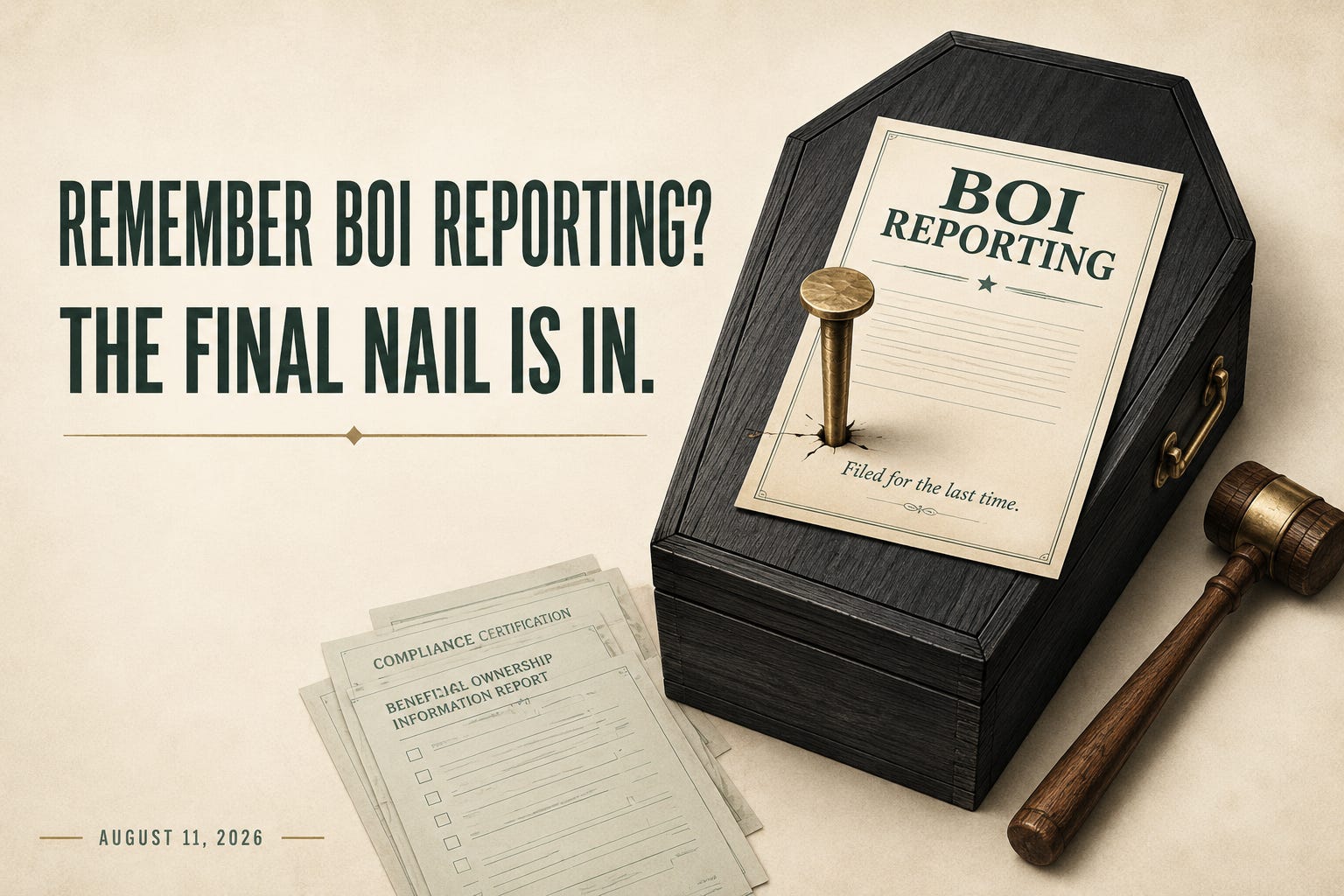
If you’re old enough to remember 2024 and 2025, you may recall the seemingly endless waiting for courts and FinCEN to decide the fate of beneficial ownership information reporting.
BOI reporting became something of an interest of mine. I still believe the underlying idea made sense. I also hoped the filing requirement might discourage people from forming unnecessary entities, or, at the very least, encourage them to obtain competent advice before doing so.
But for most businesses, BOI reporting is now officially over.
In an August 11 final rule, the Financial Crimes Enforcement Network formally exempted U.S. companies and U.S. persons from BOI reporting. The rule becomes effective upon publication in the Federal Register.
What Happens to Information Already Filed?
FinCEN says it will delete previously submitted information when it reasonably believes the information relates to a U.S. person. This includes information about:
Beneficial owners;
Company applicants; and
Individuals who obtained FinCEN identifiers.
According to FinCEN’s new frequently asked questions, affected individuals do not need to request deletion. FinCEN will identify U.S.-person information using indicators such as a U.S. passport or driver’s license and remove it from the BOI database.
FinCEN ID holders who are U.S. persons also have no obligation to update or correct the information they originally submitted to obtain their identifiers.
Who Still Has to Report?
The Corporate Transparency Act has not disappeared entirely.
An entity may still be a “reporting company” if it:
Was formed under the laws of a foreign country;
Registered to do business in a U.S. state or Tribal jurisdiction; and
Does not qualify for another exemption.
Even then, the foreign reporting company is generally required to report only information about foreign beneficial owners. It does not report U.S. persons as beneficial owners, and U.S. persons are not required to provide their information for the report.
The final rule also eliminates the requirement for foreign reporting companies to identify U.S. persons who acted as company applicants—that is, individuals who assisted the foreign entity in registering to do business in the United States.
FinCEN’s FAQs explain that a foreign entity registered to do business in the United States generally must file its initial BOI report within 30 calendar days after receiving notice that its registration is effective. Foreign reporting companies must continue to evaluate whether another regulatory exemption applies.
What Should Firms Do Now?
For tax and accounting professionals, this ends the issue for domestic clients. They do not need to file.
Firms should consider:
Removing BOI filing reminders for domestic companies;
Disabling automated BOI follow-up emails;
Updating client organizers, engagement letters, checklists, and website guidance;
Advising prior filers that they do not need to update or correct their reports; and
Preserving a separate review process for foreign entities registered to do business in the United States.
Clients who previously filed do not need to submit another report to withdraw their information or claim the new exemption.
A Predictable Ending to a Very Loud Debate
None of this should be particularly surprising. The current administration had already made clear that BOI enforcement against U.S. companies and U.S. persons was not a priority.
Before that, however, BOI reporting became a hotly debated subject on social media. Some viewed it as government overreach. Others argued that helping clients prepare BOI reports constituted the unauthorized practice of law.
In the vast majority of cases, it did not. I thought I would say that again, because I know I said it 1,000 times in 2024 and 2025.
Helping a client gather information and submit a government filing does not automatically become the practice of law merely because the filing concerns a legal entity. As with many professional-services questions, the answer depended on what assistance was being provided, not simply on who clicked the submit button.
The Bottom Line
BOI reporting is over for U.S. companies and U.S. persons. Domestic entities have no filing obligation, prior filers have no continuing update obligation, and FinCEN says it will delete the U.S.-person information it previously collected.
The remaining reporting population consists primarily of certain foreign entities registered to do business in the United States, and even those entities generally report only their foreign beneficial owners.