


This started as a conversation about books.
Anytime I travel anywhere, there are two things I seek out: independent bookstores and coffee shops. If those two are in the same location, all the better. There is now a third: record stores, because I have fallen in love with vinyl, and the vibe is really cool . But primarily, bookstores and coffee shops.
Shannon Hall and I were in Cleveland, both speaking at NATP Taxposium, which was a really great event. When we weren’t speaking, instead of going to classes, we decided to find other things to do. Obviously, a bookstore and a coffee shop were on the list, and of course a ghost tour. There’s always a ghost tour with Shannon.
Cleveland deserves credit here. Shannon is vegan (which is something I aspire to), which turns every conference city into a small logistical research project, and Cleveland turned out to be genuinely good at it — one excellent meal after another. The Tofu wings were excellent. One exception: a restaurant that had apparently decided dill belonged in every single item on the menu. Not as an accent. As a governing principle. Dill is one of those things that I do not like. I have never liked it, and I probably never will, and I don’t have to.
Somewhere between a cappuccino, a chocolate chip cookie, and a conversation about books, we thought it would be really fun to have a podcast where we talk about books. Then it grew. Because it turns out you cannot get two Enrolled Agents talking about anything for very long before the conversation finds its way to a Tax Court opinion somebody misread, or a vendor claim that doesn’t survive contact with §7216, or the fact that an IRS publication has never once been primary authority. The books stayed. Everything else moved in around them.
So we recorded it.
Well, Actually… is now live on Apple Podcasts, Spotify, and YouTube, and it will be here on Substack too. Episode 1 is up. It’s called “We Passed, We Traveled, We Have Opinions,” which is an accurate summary and also the entire pitch.
What the show is
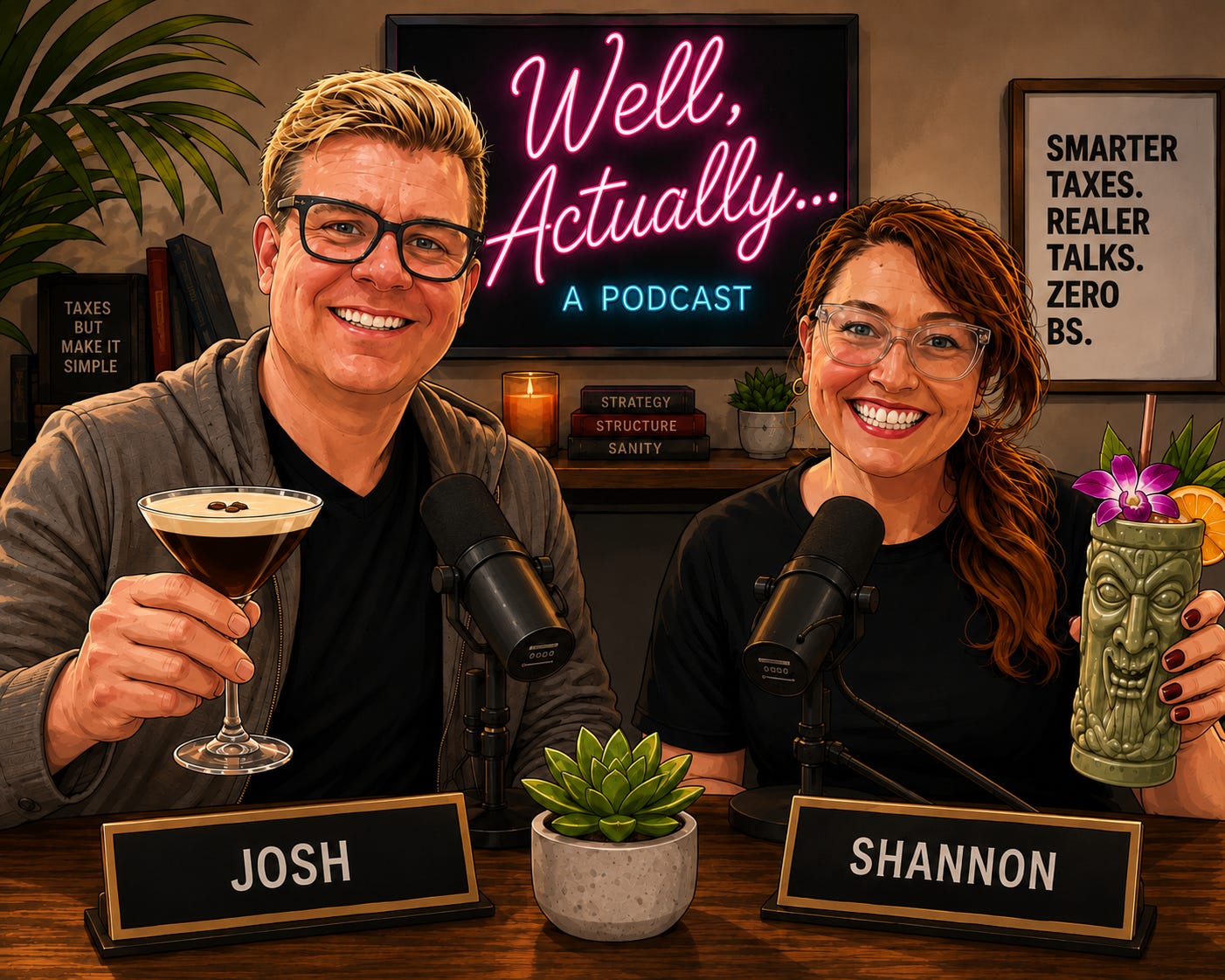
Shannon Hall is an Enrolled Agent in Long Beach, California, and the president of CSTC (California Society of Tax Consultants). Earlier this year, we both sat for — and passed — the U.S. Tax Court non-attorney exam. We are currently awaiting admission.
The premise of the show is friendly pedantry. Getting the detail right matters. The difference between a primary source and a persuasive one matters. And “I don’t know” is a perfectly good answer as long as it’s followed by “let’s find out.”
That means no hot takes. It means we cite things. And it means that when something we believed turns out not to survive a look at the source, a rule one of us misremembered, a claim the whole profession repeats because the whole profession repeats it, we say so out loud. That's the well, actually.
It also means the show isn’t only about tax. We both read constantly, both work in a profession being reshaped in real time by software that most of its vendors can’t accurately describe, and both have opinions about coffee, ghost tours, and whether hardbacks are still worth buying if you’re going to read the Kindle edition anyway. All of that is in scope.
What’s in Episode 1
A debrief of a summer that ran through Reno, Cleveland, and New Orleans:
The Tax Court exam — what it actually takes, what the pass rate looks like, and why you don’t need a master’s in taxation to sit for it
The AI vendor hall — the gold rush currently happening in conference exhibit spaces, and the §7216 question that most vendors would prefer you not ask
WISPs and MFA — the data security obligations that a lot of practitioners are still treating as optional
A five-hour research spiral in a rented house in the desert, which produced the first official well, actually of the series: an IRS publication is not primary authority. It never has been. It can also, it turns out, simply be wrong.
Runtime is about thirty minutes.
Where this is going
A few things we’re planning, in rough order of how soon you’ll see them.
A regular release cadence. Episode 2 is already in motion. The failure mode for new podcasts is not the launch, it’s the six-week gap after the launch.
Guests. This is the part I’m most looking forward to. The profession is full of people who are extraordinarily good at a narrow, difficult thing and almost never get asked to explain it at length. We’re going to have them on and let them talk. We will also have people we respect and make a difference.
More tech and AI, treated seriously. I’ve spent thirty years in tech, and I’ve watched this industry adopt technology in a way that is by turns admirable and alarming. There’s a real conversation to be had about what these tools can do, what they cannot do, and what your professional obligations are when you point one at client data. We intend to have it, repeatedly, with people who know more than we do. But it will be done in a fun and easy-to-understand way. No complex dissertations.
Books. Fiction, nonfiction, the occasional detour into nuclear brinkmanship. This isn’t a bonus segment at the end of the tax talk. It’s the thing the show was originally going to be, and we’re not giving it up.
More snark. Episode 1 is, by design, mostly a debrief — two people catching up after a summer apart. If you came in expecting sharper elbows, fair. They’re coming. Well-intended snark is one of the load-bearing pleasures of this profession, and we were on our best behavior for the first take. That won’t hold. This industry has some toxicity in it, and we will go there. We will also stay firmly PG-13 (also known as 1 espresso martini instead of 2) while we do.
If there’s someone you want to hear from, or a topic you’d like us to explore, please reach out.
One last thing. I have said, out loud, more than once, that I would never do public speaking. I have also said I would never have a podcast. I now teach continuing education, and I am announcing a podcast in the same paragraph, which suggests my predictive accuracy about my own behavior is somewhere below that of a coin toss.
I started speaking because, as a child, I had a speech impediment, and as an adult I got the idea from a book that if you do hard things you don’t want to do, you’ll eventually enjoy it and be better off for it. Also, thankfully, as a child, I had speech therapy (Ms. Sloan). Thanks, Mom.
So if you get tired of hearing me, blame my mother. :)
How to listen
Spotify —
YouTube — https://www.youtube.com/@wellactuallytax
RSS (for the Overcast, Pocket Casts, and Castro contingent) — https://api.riverside.com/hosting/lTiHAKvf.rss
Substack — right here. New episodes will land in your inbox with show notes.
The website — https://wellactually.tax
If you listen and it lands, the single most useful thing you can do is leave a rating on Apple or Spotify.
Nothing in this podcast constitutes tax, legal, or accounting advice, and no client relationship is formed by listening or by reading. We discuss general principles. Your situation has facts in it. Facts matter.